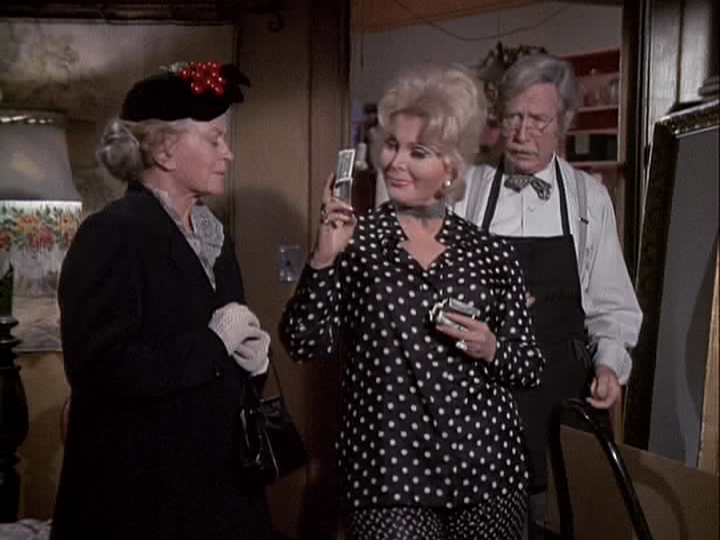
“Deliveries in the Rear” (NIGHT GALLERY, originally
broadcast 2/9/1972)

For the record, I have always enjoyed stories about 19th century grave robbers.
There is a certain thorny, fertile dynamic at play in this singular moral quandary
between lowly, sometimes murderous body snatchers (also known as “resurrection
men”) and the unscrupulous doctors who hired them—invariably resolute in their claim to the furtherance of medical science.

A good many stories of this type (including Robert Louis
Stevenson’s “The Body Snatcher”) were inspired by the infamous case of Burke
and Hare, a pair of Edinburgh, Scotland grave robbers who in 1828 were suspected of 16
murders, the victims of which were sold for dissection (in anatomy lectures) to
a physician named Robert Knox. Which brings us around to this particular segment of Night Gallery,
“Deliveries in the Rear”, written by Rod Serling and starring Cornel Wilde and Rosemary Forsyth.


The story opens with the telltale, relaxing clip-clop of horseshoes on cobblestone, a dense early morning fog obscuring all but a passing carriage. As it pulls to a stop near the rear-entrance of a medical school, two men climb off, acting with a degree of trepidation as they begin to unload their cargo. It’s immediately apparent by their behavior—and by that of the man who receives them at the door—that what they are delivering is a cause of great concern.
"Tell Dr. Fletcher we’ve brought…"
"Never mind what you’ve brought! Bring them in."


The story opens with the telltale, relaxing clip-clop of horseshoes on cobblestone, a dense early morning fog obscuring all but a passing carriage. As it pulls to a stop near the rear-entrance of a medical school, two men climb off, acting with a degree of trepidation as they begin to unload their cargo. It’s immediately apparent by their behavior—and by that of the man who receives them at the door—that what they are delivering is a cause of great concern.
"Tell Dr. Fletcher we’ve brought…"
"Never mind what you’ve brought! Bring them in."

At the moment, the aforementioned
Dr. Fletcher (the perfectly cast Cornel Wilde) is busy with a lecture, teaching
a group of young men the tenets of surgery.
Aiding this class is a subject of dissection, a cadaver that has seen
better days and causes a bit of queasiness with one student, who refers to it, breath bated, as “unappetizing”.


“My dear would-be Dr. Tuttle…this
poor, dead, nameless wretch is not on the restaurant menu.”
This elicits laughter from the class, except Tuttle (a young Gerald McRaney), who promptly faints dead away.
This elicits laughter from the class, except Tuttle (a young Gerald McRaney), who promptly faints dead away.

And it’s the first example of a
certain determined indifference on Fletcher’s part towards his subjects of
dissection, and more importantly, to "the sanctity of life itself", to quote Rod Serling, who has plenty to say on the matter (through the mouths of his characters). In his efforts to develop young physicians of
a certain steely resolve, he regards his cadavers as objects and little more. The means of acquiring these cadavers, by extension, holds for Fletcher even less importance.

When the class lets out, the good doctor is led by his assistant, Jamie (Walter Burke), to meet his suppliers, a grimy, ghoulish pair of bottom scrubbers (Peter Whitney and John Maddison) who've lugged with them a pair of neatly-wrapped corpses. After admonishing them for the first one he examines, a rotter that has been dead for weeks, Fletcher is assured the other cadaver will exceed his expectations.

"Oh, but, doctor—you'll be pleased with this one. Oh, this one's an absolute Jim Dandy."
"More like it...not even rigor mortis here—this man has been dead less than two hours."

"You said you preferred 'em fresh, doctor."

And in this moment, the true span of Dr. Fletcher's moral compass is revealed. The highly esteemed professor and physician, known to most as a noble healer and saver of lives, has become complicit in murder.

After his rather unsettling guests have departed, Fletcher and his assistant have a closer look at the new cadaver. "Oh, dear god!"
"Dead about 2 hours."
"The man's been bludgeoned...."
"Mmm-hmm...skull fracture and instantaneous death, from the look of it. You know, Jamie, it's a moot question as to whether or not our suppliers merely disturb death or actually cause it, hmm? However, if I'm to teach young men the art of surgery, I cannot allow myself the luxury of moral outrage."

Absolving himself any personal responsibility, Dr. Fletcher heads off to dinner with his fiance, telling his troubled assistant as he leaves, "Come now, Jamie. No one else mourned him. Why should you?"

At the family home of his young fiance, Barbara, Dr. Fletcher listens as his lovely bride-to-be plays the organ. It's clear he isn't completely without humanity, as his love for the young woman is quite apparent.


As the song ends, Barbara's father asks for a word with Fletcher in private. It seems Dr. Fletcher's future father-in-law (Kent Smith) has been made aware of the dubious nature in which the physician acquires his cadavers. A senior administrator at the medical school, Dr. Shockman (Peter Brocco), is friendly with the father and has made his growing disapproval of Fletcher's methods known. And what begins cordially enough quickly escalates into a bitter standoff.

"About these cadavers..."
"What about them?"
"Dr. Shockman went as far as to suggest that...they were the victims of foul play."
"I have no doubt."
"You mean you'd accept(?!)..."
"What Dr. Shockman did not say is that if they are indeed the victims of a knifing, a bludgeoning, a garrote, the victim, in each case, is himself a piece of scum. A drunk, a derelict, a felon, a nameless wandering nonentity whose death goes quite unnoticed."


"John, you can't!"
Fletcher follows with further justifications, that in death these individuals (having never amounted to much), finally have a purpose, and that no one life is worth its weight against progress made in the name of medical research.
"I submit to you, John—that may be professionally expedient, but it is neither right, nor just, nor moral!"

Catching her two favorite men in the midst of the rather acrimonious exchange, Barbara interjects cautiously.
"It appears that I've absented myself too long."
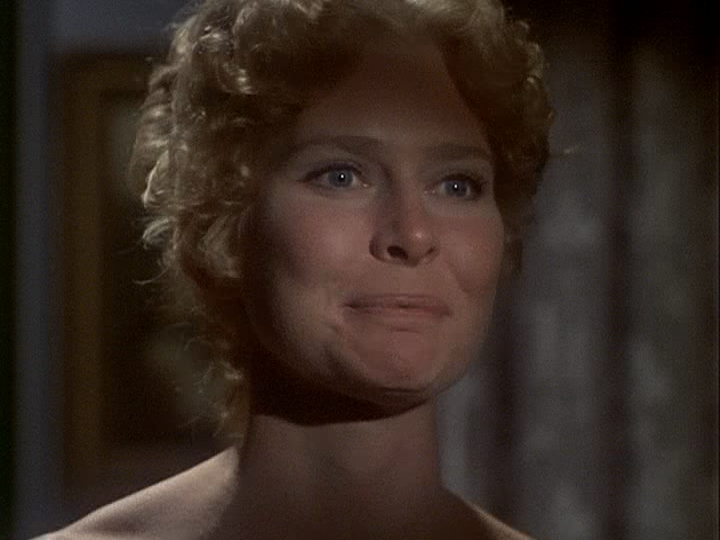
"Well, your father and I had a minor disagreement, but it's finished."

"I don't consider it a minor disagreement, and it's hardly finished. We'll talk about this again, John."

That evening as he arrives home, Fletcher is confronted by an irate, drunken elderly peasant woman (Marjorie Bennett) who claims her husband Charlie has been murdered and sold to the doctor for dissection.
"You've got me Charlie! You've got him in that hellhole of yours. You've got him lying on a slab, and every day you cut into him! Every day!"

"Now, you listen to me, mother. I don't have your Charlie. I don't even know who Charlie is. But if you don't get off my front steps, I'll have a policeman here in a minute and then you'll see."

"Don't give me that about a policeman! Don't give me that! That's what I should've brought here first. You're no better than the ghouls you hire! You're just a ghoul yourself! That's what you are. You're just a ghoul!"

The next morning at the school, Fletcher is confronted by the aforementioned Dr. Shockman, who has now also met with the distraught old woman. It appears the police will be paying the school a visit today, and if they find ol' Charlie's remains on the premises, Fletcher can forget about the wedding, his career...everything.

Assuring Dr. Shockman that this woman's missing husband isn't in the building, Dr. Fletcher peppers his indignation with yet another falsehood.
"Dr. Shockman, we have no male subject here at all. As a matter of fact, we have the body of a woman, which should lay at rest any interest the police might have in the matter."
"I hope for your sake, that is the case...for the time being, I would discontinue the dissection of humans. Use animals."
"Animals? Dr. Shockman, we are trying to graduate a class of surgeons here, not taxidermists!"

"Better taxidermists than sanctimonious collaborators in murder!"
And following Shockman's exit...


And so in a dash to produce a female corpse, Fletcher's ghouls set out on the town.


 |
| And passing through the frame at a brisk pace, a somewhat familiar face... |