Saturday, October 8, 2016

a midnight stroll over hallowed ground


CHILDREN SHOULDN’T PLAY WITH DEAD THINGS (1972, d: Bob Clark)


In one of the darker, danker recesses of the now-distant past, there lies a small island whose only occupants can’t decide on which side of eternity they belong.


And here comes a pseudo-groovy theatre troupe, rowing in boats, grotesquely posturing and deriding their grim whereabouts.  A cemetery is no place to play.  Death will not be mocked.


And so we witness Alan (Alan Ormsby), their leader—a  slithery, loathsome, imperious fiend bent on defiling everything sacred—gleefully ham it up while conducting a mock-séance to raise the dead.  Give a man a warlock’s robe and it goes straight to his head every time.

Alan Ormsby, Esq.

But be ever-careful what you wish for, dear boy.  Alas, Alan is so obnoxious he even manages to offend the people buried in the ground, who have little to no business taking offense to anything.


The cemetery is rumored to be stocked to the gills with perverts, maniacs and murderers, so Alan’s randy assemblage of actor-y ne’er-do-wells will feel right at home. 

Anya Ormsby, one of the wonderful weirdos of CHILDREN SHOULDN'T PLAY WITH DEAD THINGS
Despite the myriad limitations of making a movie on a microscopic budget, director Bob Clark (PORKY'S, A CHRISTMAS STORY) manages to eke quite a considerable amount of eldritch atmosphere out of a naturally foggy setting and creepy, hypnotic score.


“It takes an artist to deal with the devil, not an insurance man with delusions of grandeur!” - Val (Valerie Mamches)
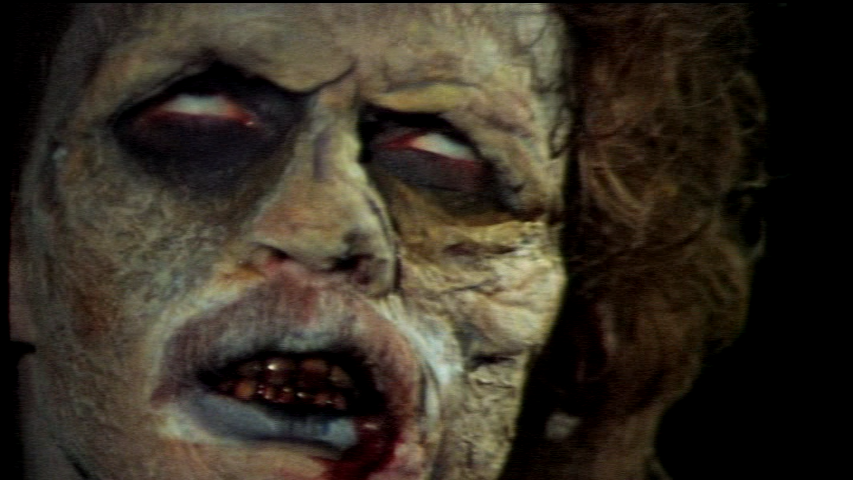
And though it takes many mouthfuls of stilted dialogue and operatic delivery to rile the pasty residents of this chilly, lonesome isle, I won't further excoriate this masterpiece of no-budget horror humdingery with details of its inherent short-comings...let us skip ahead to the part that gave me nightmares when I saw this on TV at the age of 5 or 6.


And so our beleaguered band of talky, maladroit misfits head to a cabin next to the cemetery to pontificate the meaning of life—or to at least figure out what the hell Alan is talking about.

"Look, we may not be poets, but we still have a right to know what's going on here."

And what, pray tell, is this business, Alan?  Simulated nuptials with a corpse?!  Are there no limits to your depravity?


But as stale banter gives way to the perverse ceremony, the final affront, the real party begins...


And portending certain doom, these corpses aren't just ravenous, automated instinct—they're mad as hell.


Tuesday, October 4, 2016

till death do us part

THE STEPFORD WIVES (1975; d: Bryan Forbes)


There is a place not too far down the road, up around the next bend a ways--a town called Stepford.  While some have swore it the perfect place to start a family, a fine area in which to settle down, we should all know better by now. 


Joanna Eberhart (Katharine Ross) knew one thing--she hadn’t wanted to leave her big, dirty city in the first place.  New York had been many things to her.  Her home, her subject, her refuge…her muse.  In New York City, things had just begun to fall into place for Joanna, despite all the trappings and inevitable soul-stifling a husband and two young children will provide.  And she was still just beginning to find herself, as so many women of late seem to be doing. 


"Daddy, I just saw a man carrying a naked lady."  "That's why we're moving to Stepford."

But then her husband, Walter (Peter Masterson), had told her he wanted to move to the country.  And before she’d even had a chance to mull it over, he’d told her about a house in a place called Stepford.  And before she knew it, they were packing their things and leaving the city that had seemed to hold so much promise for the fledgling young photographer.

Walter-"Ever make it in front of a log fire?"  Joanna-"Not with you."

Perhaps Walter had known it would be difficult to pull her away, and so he’d resorted to a bit of underhandedness, rushing things through, telling her it was a done deal before she could say no.  Perhaps he was trying to make her more mother by removing the artist from her subject.  But what lie ahead in Stepford was something neither Joanna nor Walter had bargained for.


While it’s clear Walter was trying to change Joanna, trying to subdue her independent streak, he seemed to be anything but a bad man.  But once he’d attended his first meeting of the Stepford Men’s Association, he’d arrived at a fateful impasse--forced to lay his cards on the table.  And those cards, facing up now, reveal more than anyone could have guessed.


And so it went that Joanna awoke late that night, alone in their bed, momentarily startled.  And when she found Walter sitting next to the fireplace with a drink in his hand, so late, she was startled once more.  What’s wrong with him tonight?  Why is he so upset? 


He’s clearly distressed—no, devastated, it seems—but no, nothing wrong, honey.  The meeting went well.  He’s decided to join the Stepford Men's Association, after all.  No, everything’s okay.  It’s just that...well.  It’s been a long night.  It isn’t easy being a father and husband, especially nowadays.  


"And you know I love you, don't you?  Don't you?"  


And she knows something terrible has happened.  But what?  What could be so awful?  He's drunk, but he isn't letting on...Why?


He has a secret.  Something has completely rattled her husband, and he seems almost ready to come clean, or at least say that he wants to chuck it all and move back to New York.


 But what?  Well, he's drunk and tired and maybe he'll sleep on it and have something more to say in the morning.  Or perhaps he's just been working too hard at the firm.  Either way, we're all moved in now, so best make the most of it.

Saturday, October 1, 2016

every witch way

“Since Aunt Ada Came to Stay” (NIGHT GALLERY, originally broadcast September 29, 1971)


In this episode of Night Gallery, we’re introduced to a most unusual, resourceful old woman, one miss Ada Burn Quigley (Jeanette Nolan).  Miss Quigley has recently moved in with her young, married great-niece, Joanna (Michele Lee), and her husband, Craig Lowell (James Farentino), a professor at the nearby university. 


From the opening moments, it’s clear that the arrangement is less than harmonious as the 90 year old Aunt Ada tends towards eccentricity, while Craig prefers things very structured and ordinary.  Ever since she’s moved in, Craig senses something not-quite-right about the woman, something he can’t quite pin down.  And yet being a professor of Logic and Scientific Method, he’s naturally averse to implausible speculation.


But when things start happening that defy explanation, the steady, reasoned professor must begin to consider other possibilities.


In all my discussions and research regarding Night Gallery, a few episodes seem to garner far more attention than the rest--this one, "The Doll" and "The Caterpillar".  I think the reasons are fairly obvious.  While Night Gallery was a horror/fantasy anthology show that emphasized frights (under the tutelage of executive producer Jack Laird), it rarely ever truly achieved them.  This episode is one of the few exceptions, as Aunt Ada seems to have left an indelible impression on many--resulting in many a sleepless night.  


Soon after we're introduced to the young married couple and the newest addition to their household, a strange game of cat and mouse begins transpiring. Ada knows Craig is of a particular breed of rational thinking men, one whose beliefs and philosophy are so deeply rooted in a seemingly infallible sense of logic that he'd never even consider the possibility of the supernatural.  And so she begins toying with him, even at the risk of compromising her ominous plans for his wife, Joanna.


Besides revealing just enough to keep Craig's head spinning, Aunt Ada has been giving Joanna herbal concoctions to drink daily, passing them off as vitamins during the day and, "herbs, dear...herbs to help her sleep", at night.


When Craig swipes a sample of the herbs to have analyzed, he finds out it’s a sea weed called Hydrodendon Barelia, without any pharmacological use, though his colleague in the lab mentions in passing that in the realm of folklore it is referred to as “the sinister witch's weed of antiquity”.  He then jestingly refers Craig to the university’s resident occult expert, the peculiar Professor Porteus (Jonathan Harris, wonderfully flamboyant as ever), whom Craig naturally views as  some kind of anathema.  


"Disbelieve if you will, but do not forget..."
Alerting Craig to the weed's use in witchcraft as a means to replace an old, dying body with that of a younger woman's, Porteus issues a stern warning to the still-skeptical younger professor, who scoffs incredulously, though not without some ambivalence.  


Following a paper trail leading to the grave of a woman buried several months back, Craig becomes convinced that "Aunt Ada" is of no relation at all to his wife, and so begins to take Porteus’ advice to heart...but is it too late?


Though Jeanette Nolan’s storied career had spanned several decades in film and television, and even saw her cast as Lady Macbeth opposite the great Orson Welles (in his 1948 film adaptation), her hair-raising portrayal of Aunt Ada might well have left the most lasting impression.  


"Don't fret, little fox-foot.  It won't be much longer."


I first saw this episode on TV about 20 years ago and, no longer a boy, I was surprised to find myself...let’s just say I was a bit more susceptible to Aunt Ada's wiles than I would like to admit--and horror, for better or worse, is in my blood. 


Speaking of which, it’s October 1st, which means I’m breaking out the horns for a month-long blog-stravaganza of things that go bump in the night.  I know, how original...  

Like I said, it's in the blood.